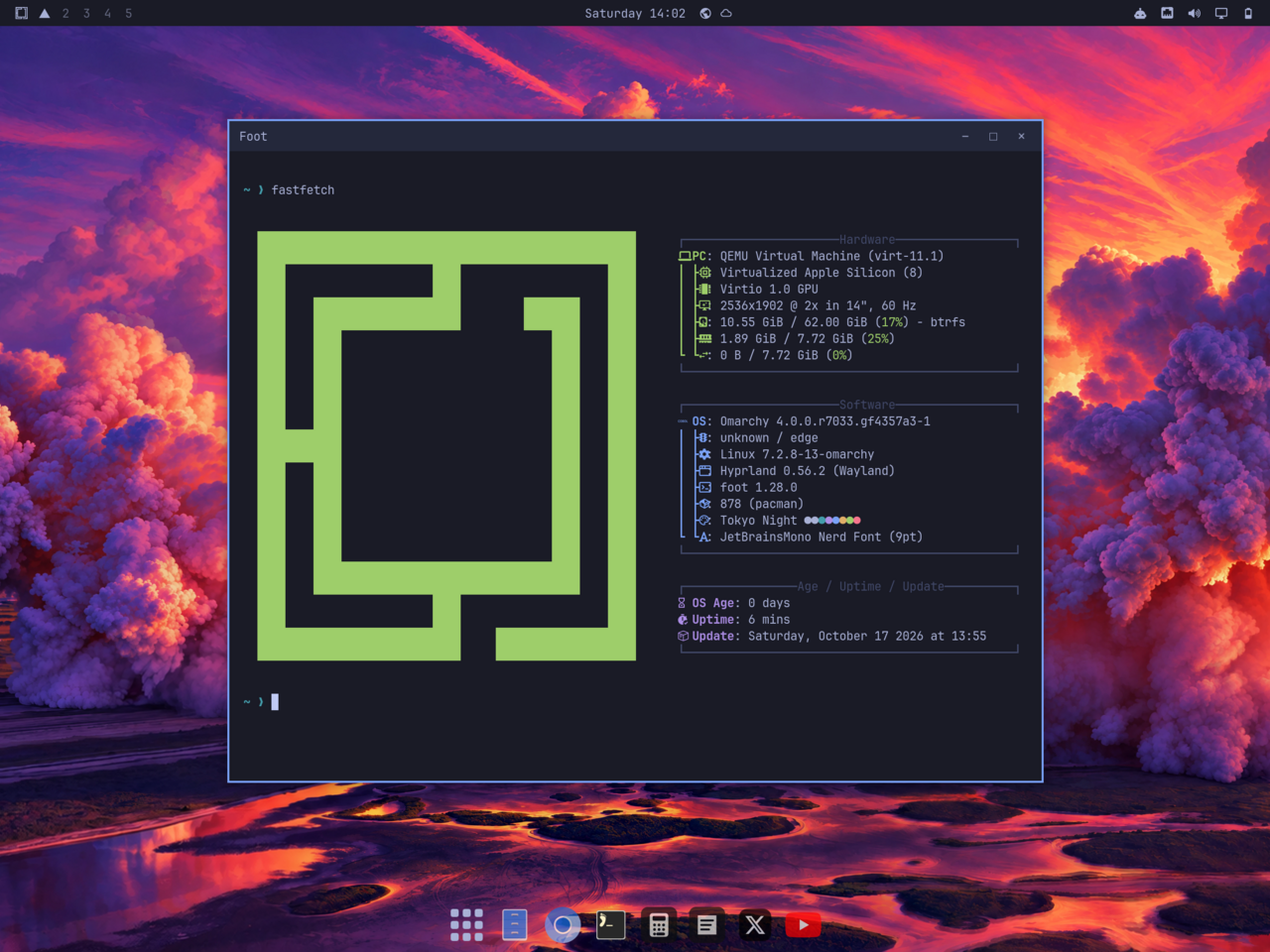
Omarchy 4.6 has been released, continuing the project's trajectory as an AI-forward Linux distribution. Backed by notable industry players, this Arch Linux-based OS continues to evolve beyond its original Hyprland customizations. The update focuses on making it easier to run local AI models on user hardware and introduces several new native applications.
Local AI and Game Vibes
To simplify local AI usage, Omarchy 4.6 now includes a curated list of open AI models that fit a system's specific memory and compute capabilities. This feature aims to remove guesswork when selecting desirable models for a user's rig. On the entertainment front, the release introduces 'Game Vibes,' an arcade for showing games made by local AI agents. The arcade also includes stock games such as chess and solitaire.
New Native Tools Replace Defaults
The distro has replaced its default file manager, Nautilus, with 'Folio,' a new Qt6-based application. This change is part of a broader set of native tools introduced in this release. Omarchy now uses 'Omaview' as its picture viewer and media player, 'Omawrite' for editing Markdown files, and 'Plain' for editing configuration files.
Browser and Hardware Updates
Google Chrome has replaced Chromium as the default web browser. The switch was made because Chrome is faster due to PGO optimizations, offers various Google integrations, and provides DRM video support for services like Netflix. Additionally, Omarchy 4.6 continues to expand its hardware support, with a specific focus on ARM laptops building on work from version 4.5.
Release Automation Issues
Shortly after the initial announcement, updates indicated that the project's release automation was off the rails. The Omarchy 4.6 tag was initially posted to GitHub but was subsequently removed and replaced with 'Omarchy 4.6-rc1.' Users looking for the latest stable build or further details on the changes should check the project's GitHub repository.
Key Takeaways
- Omarchy 4.6 adds a curated list of open AI models tailored to system memory and compute capabilities.
- 'Game Vibes' is a new arcade feature for displaying games created by local AI agents.
- The distro replaces Nautilus with 'Folio,' a Qt6-based file manager, and introduces Omaview, Omawrite, and Plain.
- Google Chrome replaces Chromium as the default browser for PGO performance, Google integrations, and DRM support.
- The initial 4.6 release tag was removed and replaced with 4.6-rc1 due to release automation issues.
The Bottom Line
Omarchy is aggressively doubling down on its identity as an AI-first distribution with native tooling and hardware-specific model curation. While the introduction of Chrome and bespoke apps signals a move toward a more cohesive user experience, the immediate rollback to an RC release highlights that the project's release infrastructure is still stabilizing.