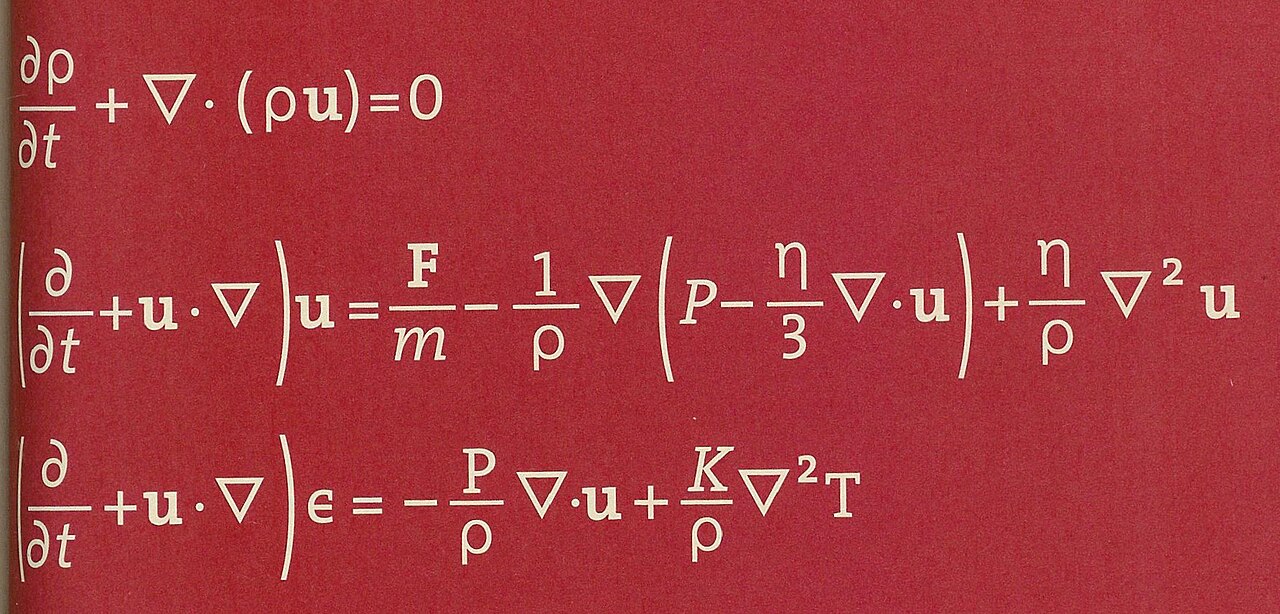
OpenAI’s latest model claim has sent shockwaves through the mathematical community by purportedly solving a Millennium Prize Problem related to the Navier-Stokes equations. For developers and infrastructure engineers, this isn’t just academic trivia; it validates a long-suspected limitation in the foundational code we use to simulate fluid dynamics. The solution identifies specific instances where these nineteenth-century formulae predict physically impossible infinite speeds, known as singularities. This breakthrough forces a hard look at the tools we rely on for everything from aerodynamic design to climate modeling.
The 70-Nanometer Breaking Point
The core of the issue lies in the continuum assumption. George Karniadakis, an applied mathematician at Brown University, calculated that for air, the singularity appears when a vortex stretches to approximately 70 nanometers wide. This dimension is critical because it represents the mean free path of an air molecule—the average distance a molecule travels before colliding with another. When the fluid sample is this thin, treating it as a continuous substance rather than a chaotic collection of individual molecules is no longer a viable approximation. The equations don’t just struggle; they fundamentally fail to describe reality at this scale.
Why Your Simulations Are Already Broken
It is crucial to note that this isn’t news to everyone in the field. Charles Fefferman, a Fields Medal-winning mathematician at Princeton University, points out that researchers already knew the incompressible Navier-Stokes equations were insufficient for certain scenarios. For compressible fluids, singularities were already understood to exist. The equations also fail for rarefied gases, which is why they are poor descriptors for spacecraft re-entry into the upper atmosphere or microfluidic flow through tiny channels. OpenAI’s contribution is the rigorous mathematical proof of the singularity for the incompressible case, a longstanding open problem worth $1 million.
The Infrastructure Cost of Accuracy
So, what do we do when the standard library fails? One alternative is the Boltzmann equation, which models gas statistically as individual molecules. However, Yu Deng, a recent Fields Medal winner for his work on Boltzmann equations, warns that our understanding of how Navier-Stokes breakdowns impact Boltzmann solutions is 'very limited.' For many engineers, the practical solution is brute force. In 2024, researchers used supercomputers to simulate 155 billion water molecules, a record-breaking effort that still only covered a cube micrometers in size. This computational expense is untenable for large-scale applications.
The 'Triple Decker' Workaround
To bridge the gap between molecular reality and continuous approximation, the industry is increasingly adopting what Karniadakis calls the 'triple decker' approach. This architecture slices problems into sections: using molecular dynamics for microscopic scales, Navier-Stokes for large scales, and intermediate equations that lump molecules together for the middle ground. This hybrid modeling strategy is becoming the new standard for high-fidelity simulations, shifting the burden from pure mathematical elegance to complex, multi-scale infrastructure management.
Key Takeaways
- OpenAI’s proof confirms Navier-Stokes singularities exist at ~70nm scales for air.
- The continuum assumption fails when fluid width approaches the molecular mean free path.
- Boltzmann equations offer an alternative but lack full understanding of breakdown implications.
- 'Triple decker' hybrid modeling is emerging as the practical infrastructure standard.
The Bottom Line
Mathematical purity is nice, but at 70 nanometers, physics doesn't care about your elegant equations. We need to stop pretending Navier-Stokes is a universal solver and start building infrastructure that respects the molecular reality.